

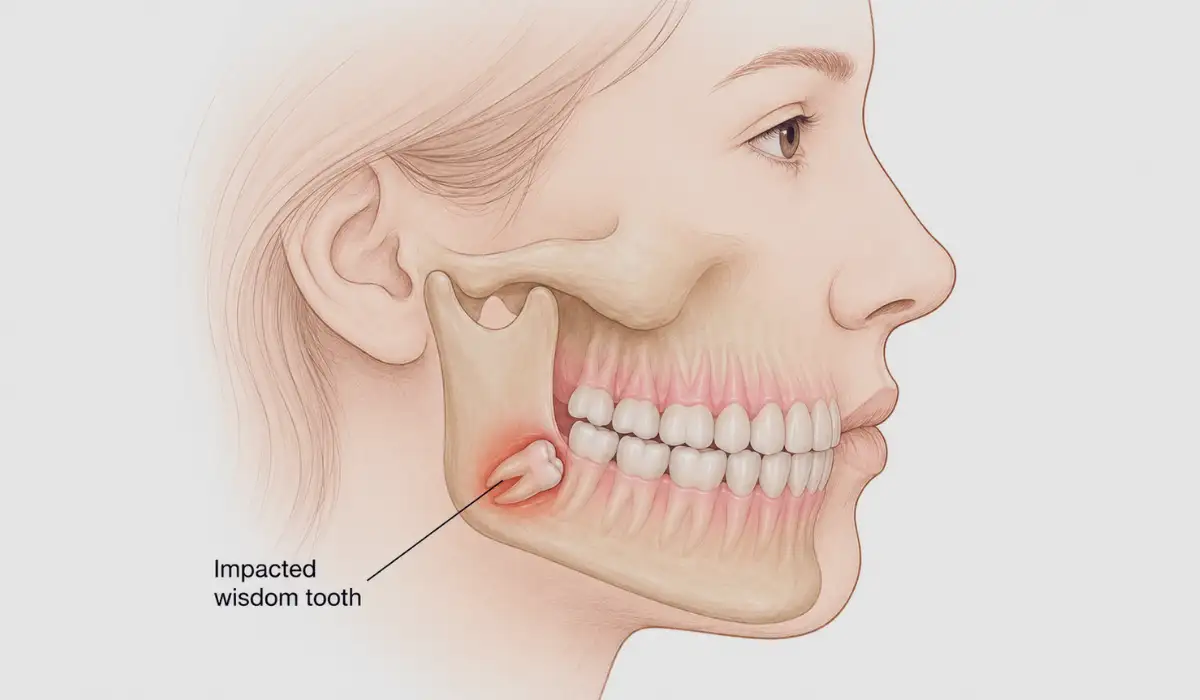
An impacted wisdom tooth is a third molar that does not grow into its proper position because gum tissue, bone, or a nearby tooth blocks its path. It may remain completely hidden beneath the gum or emerge only partway into the mouth.
Wisdom teeth are the final permanent teeth to develop at the back of the mouth. Because they appear after the other adult teeth, the jaw may not have enough space to accommodate them. An impacted tooth may remain painless, but it can also cause infection, decay, gum inflammation, or damage to a nearby molar.
Why Do Wisdom Teeth Become Impacted?
Wisdom teeth usually begin emerging during the late teenage years or early adulthood. Impaction commonly happens when there is not enough room behind the second molars for the new teeth to develop normally.
The tooth may grow at an angle, press against another molar, or remain trapped inside the jawbone. Jaw size, tooth position, and the direction of growth can all influence whether a wisdom tooth becomes impacted.
Not everyone develops all four wisdom teeth, and not every impacted tooth causes symptoms. Regular dental examinations and imaging help determine whether a tooth is healthy or likely to create future problems.
Types of Impacted Wisdom Teeth
Dentists usually describe an impacted wisdom tooth according to how much of it has emerged and the direction in which it is growing.
Partially Erupted Impacted Wisdom Tooth
A partially erupted impacted wisdom tooth has broken through the gum but has not emerged completely. A flap of gum tissue may continue covering part of the crown.
Food particles and bacteria can become trapped beneath this flap because the area is difficult to brush. This may lead to inflammation or infection around the tooth, known as pericoronitis. Partially erupted teeth are also more vulnerable to tooth decay and gum disease.
Completely Impacted Wisdom Tooth
A completely impacted tooth remains beneath the gum or inside the jawbone. It may not be visible when looking inside the mouth and might only be discovered during a dental X-ray.
Although some completely impacted teeth remain stable, others may develop cysts, affect the surrounding bone, or damage the roots of nearby teeth.
Horizontal Impacted Wisdom Tooth
A horizontal impacted wisdom tooth grows sideways rather than upward. Its crown may point directly toward the second molar in front of it.
This position can place the impacted tooth close to the neighboring molar and may contribute to decay, gum problems, or root damage. Horizontal and forward-angled impactions have been associated with damage affecting the adjacent second molar, so careful dental assessment is important.
Other wisdom teeth may grow vertically, lean toward the front of the mouth, or angle toward the back of the jaw.
Common Impacted Wisdom Tooth Symptoms
An impacted tooth may not cause noticeable symptoms at first. Problems often develop when bacteria collect around the surrounding gum or when the tooth presses against nearby structures.
Common infected wisdom tooth symptoms include pain or tenderness at the back of the mouth, red or swollen gums, bleeding around the tooth, and jaw stiffness. Some people may also have difficulty opening their mouth fully, chewing, or swallowing. Bad breath, an unpleasant taste, cheek or jaw swelling, and food repeatedly becoming trapped behind the second molar may also suggest irritation or infection.
These symptoms can point to gum inflammation, tooth decay, or pericoronitis. Wisdom tooth pain that becomes severe, persistent, or accompanied by facial swelling, fever, pus, or difficulty swallowing requires prompt dental care.
Problems an Impacted Tooth Can Cause
Impacted wisdom teeth are difficult to clean properly. Plaque and food can accumulate between the wisdom tooth and the neighboring molar, increasing the risk of cavities and gum disease.
A partially erupted tooth may repeatedly develop pericoronitis. An impacted tooth can also damage the second molar, affect the surrounding bone, or develop a fluid-filled cyst. These problems are among the common reasons dentists recommend extraction.
However, an impacted tooth does not automatically need surgery. Teeth that remain free from disease may sometimes be monitored through routine examinations and dental X-rays.
How Is an Impacted Wisdom Tooth Diagnosed?
A dentist will examine the gums and the back of the mouth for swelling, tenderness, trapped food, decay, or signs of infection.
A panoramic dental X-ray can show the tooth’s position, root shape, surrounding bone, and relationship to the second molar. It can also help identify wisdom teeth that remain completely below the gum.
The dentist may refer the patient to an oral surgeon when the tooth is deeply impacted, positioned near an important nerve, or expected to require a complex procedure.
When Is Impacted Wisdom Tooth Removal Needed?
Impacted wisdom tooth removal may be recommended when the tooth causes repeated pain, infection, unrestorable decay, gum disease, cyst formation, or damage to a neighboring tooth.
Removal is usually performed using local anaesthesia. Sedation or general anaesthesia may be considered for difficult extractions or significant dental anxiety.
The surgeon may open the gum, remove a small amount of surrounding bone, and divide the tooth into sections so it can be removed safely. The exact procedure depends on the tooth’s depth, position, and root structure.
What Happens After Removal?
Temporary swelling, soreness, mild bleeding, and jaw stiffness are common after surgery. Knowing how to care wisdom teeth extraction sites can support healing and reduce complications. Patients are usually advised to eat soft foods, avoid smoking and straws, and clean the area gently according to their surgeon’s instructions.
After removing an impacted tooth, the protective blood clot inside the socket should remain undisturbed. If the clot comes loose too early, dry socket may develop and cause severe pain that begins or worsens several days after extraction.
Conclusion
An impacted wisdom tooth is unable to emerge normally because its path is blocked or there is insufficient room in the jaw. It may be completely hidden, partially erupted, or positioned sideways.
Not every impacted tooth requires immediate removal. However, recurring infection, decay, gum disease, cysts, or damage to nearby teeth should be evaluated promptly. A dental examination and X-ray can determine whether monitoring or extraction is the safer option.
FAQs
Yes. A disease-free impacted tooth may sometimes be monitored with dental examinations and X-rays. Removal becomes more likely when pain, infection, or damage develops.
No. Some impacted teeth remain painless for years. However, cavities, gum disease, cysts, or neighboring-tooth damage can occasionally develop without obvious early symptoms.
It is not automatically dangerous, but trapped food and bacteria can cause pericoronitis, decay, swelling, bad breath, or repeated infections requiring professional dental treatment.
Yes. A sideways wisdom tooth may press against the second molar and contribute to decay, gum problems, root damage, or loss of supporting bone.
A dentist uses an oral examination and dental X-rays. Panoramic imaging shows hidden teeth, their roots, surrounding bone, nearby molars, and important nerve structures.
Initial soreness and swelling usually improve gradually during the first week. Complete healing takes longer and depends on the extraction’s difficulty and individual recovery.